Monday, October 1, 2012


Dr. Gregory Curnew 'Spreads the Health'


Environment Hamilton is very thankful for all the work Hamilton Cardiologist Dr Gregory Curnew has done to help grow our Good Food Box program.  His office distributes as many as 90 Good Food Boxes a month to patients and that number is expected to grow!

As a cardiologist, Dr Curnew does a lot of work to promote healthy living.  He highlights the link between diet and disease in order to prevent illness before it happens.  Dr Curnew suggests that we all need to eat more of the four following types of food: fruits and vegetables, good fats, grain products, and milk and soy products.  By promoting the Good Food Box Dr Curnew has made the fruits and vegetables we all need to thrive available to people who often have a limited budget.

The Good Food Box costs only $15 and includes 11 different fruits and vegetables.  
Alternatively, the program also offers the Eat Local Box,  which might be more appealing to Environment Hamilton members who are keen to support very local, sustainable agriculture.  The Eat Local Box also contains 11 different fruits and vegetables—all locally sourced.  Both boxes are offered year round.  The Eat Local Box costs $27 and provides a subsidy to help the Good Food Box program become more financially and environmentally sustainable.

We already have more than 10 distribution sites across Hamilton  but we are always looking to expand into places like Dr Curnew’s medical clinic. 

If you think that your workplace, church, or community might be interested in helping this important program to grow we would love to work with you.
Contact Karen Burson at Environment Hamilton for details.


Friday, February 3, 2012

Poster Contest


POSTER CONTEST

Green Venture and Clean Air Hamilton have partnered to host our second Fighting Climate Change poster contest for Hamilton high school students.
Create a poster encouraging your peers to take action on climate change.  Express an action that people can take to combat climate change and lessen their impact on the planet.  
Make a poster, win great prizes, and get your work seen!  Deadline for entries is Feb 22nd at 4pm.  See details here.
All works will be displayed at an opening reception at Central Library on April 13th, as part of the James St N Art Crawl!  Top works will be displayed in the main lobby at Central Library, at Eco House during Doors Open Hamilton, and the Skydragon Centre (Homegrown Hamilton) for the month of June (including the June Art Crawl) and at other art events TBA. 

1st prize: 1 day workshop of your choice at the Print Studio, 1 year membership at the Art Gallery of Hamilton, $50 gift certificate at Mixed Media
2nd prize: 1 day workshop of your choice at the Print Studio
3rd prize: $50 gift certificate at Mixed Media
Get ideas for your poster:
The world’s climate is changing at a dangerous rate due to high levels of greenhouse gases (GHGs) in our atmosphere.  Many GHGs, such as carbon dioxide (CO2), are naturally abundant and harmless but society produces them at such high rates that it is leading to harmful, planet-wide changes. For more information on climate change and GHGs start here:
It may sound overwhelming, but you can make a difference!  Every time fossil fuels (like oil and natural gas) are used as an energy source, GHGs are released.  Every small action you take to reduce your energy consumption also helps reduce the amount of GHGs entering our atmosphere, helping your community and our planet!  This is your chance to inspire other youth to fight climate change.  All actions help, and every way that we can reduce our use of green house gases will help reduce the impacts of climate change.

Help our environment, inspire others to take action, get your work seen, and win some great prizes!   
Contest Regulations
Poster must be created by Hamilton high school students, and can be made by either individuals or groups.  Any media is acceptable as long as it is on 11"w X 17"h paper (279X432mm / ledger size).  Submit original artwork by 4pm on Feb 22nd, 2012 to Green Venture at 22 Veevers Dr., Hamilton.  Poster must be accompanied by completed registration form and artist statement.  View registration form here.  Digital entries must be 300 DPI and can be submitted to air@greenventure.ca
Posters will be judged by members of Hamilton's artistic, environmental, and educational communities.  Your poster will be judged on creativity, message clarity, composition, and how well it portrays a tangible action and encourages people to take action.  Results will be announced on March 7, 2012.   

If you have a question, contact air@greenventure .ca or call 905-540-8787 ext. 113.
To see our winning entries from last year, check out our blog
Further details about art showings will be posted, so visit us again.

We can’t wait to see your posters!

Sunday, January 8, 2012

Building Renewable Energy Co-operatives


The Hamilton Halton Energy Awareness Team (HHEAT)
Presents
Building Renewable Energy Co-operatives 
 
2012 Workshop Series

Overview of the co-op model/Technology and Site Selection.
You will learn about how the community renewable energy co-operative business model works and the basics of renewable energy installation technology and site selection..
Bill Thompson, Hamilton Coordinator Blue Green Canada.
Martin Ince, Project Developer, M.K. Ince and Associate Ltd, Renewable Energy and Environmental Consulting 

Halton: Tuesday, January 24th 2012 Oakville Town Hall from 6.30-9.30 pm.
 
Hamilton: Wednesday, January 25th 2012 Laidlaw United Church from 6.30-9.30 pm

Tuesday, November 29, 2011

McMaster Innovation Park (MIP) Tour


Nov 28th-Thanks to the staff at the MIP for a wonderful tour.CEO, Zach Douglas gave a presentation of the history of Innovation Park then show the group around the Atrium and the CANMET-MTL building. There was a focus on the renewable energies being employed as well as what makes the building a model of sustainability.

Wednesday, November 23, 2011

Hamilton Climate Change Charter

Environment Hamilton participated in the development of the Hamilton Climate Action Charter. This is an exciting development as Hamilton will be the first community in Ontario to create such a Charter.  A copy of this Charter can be downloaded from the Hamilton Climate Change Champions web site. Many Hamilton organizations are signing up,  and you can too as an individual, family, organization or business through the Hamilton Climate Change Champions website.
​The Charter was signed by Mayor Bob Bratina on behalf of the City of Hamilton on Wednesday October 26th 2011.
The Council of Canadians has developed resources at systemchange.ca to discuss the changes needed for the community to reduce the impact our current way of life has on the earth's climate. Localization of the economy, reduction of fossil fuel use and a change from a "growth economy" are all discussed.

Saturday, November 12, 2011

Building Community Power Co-operatively

If you are interested in decentralizing power generation in our community, and if you are interested in investing in community power generation (solar and wind) then get involved with the HHEAT project (Hamilton Halton Energy Awareness Team). Check out the Environment Hamilton website and the HHEAT blog for details and updates.

Living the Environment Conference 7


Our Katimavik volunteer is fantastic!

Meditation Workshop


This workshop took place on October 26th at first Unitarian Church Hamilton on Dundurn St. South.
We learned the basics of meditation with instructor Kelly Hilton.

About the Instructor:
Kelly Hilton’s experience in meditation began through yoga training in the Hindu community. Realizing
the many benefits of meditation, Kelly expanded her knowledge by attending numerous workshops and
retreats on topics including meditation philosophy, meditation as life-style, raw foodism, and pranayama
(breath control). Over the last 16 years, Kelly has maintained an intensive Ashtanga yoga practice.

Sunday, October 2, 2011

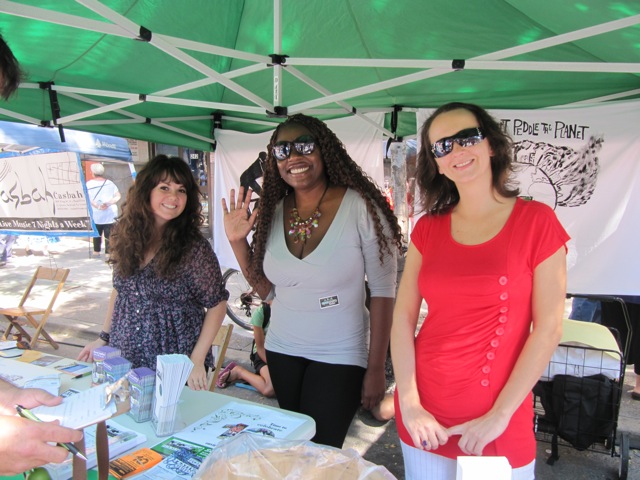
Volunteers at the Westdale Culture Day Festival, October 1st

Thanks to our volunteers, Nadia, Emma, Reem, Joy and Maria!

Tuesday, September 27, 2011

Hamilton Naturalist Club

Sept-24th- Jen Baker came out from the Hamilton Naturalist Club and shared a talk with the youth group on how our youth group could work with the Naturalist club. She talked about habitat restoration, removing invasive species, documenting healthy trees and on the club's properties as possible volunteer and learning opportunities.
She talked about the North end project (restoring Nature in Hamilton's north end) that we could as a group help expand on- into a more naturalized area that would benefit the urban environment.

She also mentioned Falcon Watch and other programs they have. We are invited to go out on a hike to the sanctuaries and they can organize a bus ride.

Monday, September 5, 2011

Poster Making Workshop

Aug 16th-Another poster making workshop. Thanks to Davey Hamada and his pal Justin for teaching us how to create our own posters using Publisher. We also gained two new members!

Saturday, August 13, 2011

DIY Natural Body Care Products

August 6-
A big thank you goes out to Amina Suhrwardy, natural body care products maverick,extraordinaire for the fantastic workshop she lead on making sun screen and a lovely facial scrub too. We learned so much and EH gained two new members!


Tuesday, August 2, 2011

Sewage Sludge – A Messy Problem

The city of Hamilton continues to grapple with what to do over the long term with the 40,000 tonnes of wet sewage sludge produced each year at the Woodward Ave Sewage Treatment Plant (STP).
Sludge is generated as a result of contributions from you and me and every other Hamiltonian who flushes a local toilet. Add to the toilet flushing the fact that many local industries also discharge their wastewater into our sewer system, and you end up with a big, messy problem with no easy solutions. The sludge generated at our centralized sewage treatment plant is laced with everything from pharmaceutical drugs and pathogens to heavy metals and other toxic contaminants discharged from local industry.
This creates problems for final disposal of the sludge; whether you spread it on farm fields or burn it in an incinerator, contaminants found in the sludge can get out into the environment.


In the case of land application, the more contaminated the sludge is, the more limited your options are for final disposal. The Ontario Ministry of the Environment regulates the land application of sludge through requirements in the provincial Environmental Protection Act and the Nutrient Management
Act. Levels of heavy metals in the sludge, such as mercury, lead and cadmium, drive regulatory decisions regarding how much and how frequently a given municipality’s sludge can be spread on farm fields.
Visit www.ene.gov.on.ca/environment/en/subject/biosolids/ for detailed information on the province’s regulatory framework.

In the case of incineration and other thermal destruction technologies, Ontario’s Green Energy Act includes sewage sludge in the definition of ‘biomass’, which is categorized as renewable, green fuel.
This has led to a fast-tracking of the approvals for facilities that are proposed to generate energy-from-waste using sewage sludge as a fuel. The problem, however, is that sewage sludge is simply not a good source of energy as it exhibits a very low BTU value (BTU or ‘British Thermal Unit’ is the measurement of heat created by burning any material). Even with the best pollution control technologies, thermal destruction of sewage sludge results in the emission of contaminants including heavy metals and cancer-causing dioxins into our air.

City Council is currently divided over how to manage Hamilton’s sludge over the long term. The majority of councillors support incineration as the preferred long-term management solution. Yet to be determined is whether the city should build its own incinerator or whether a partnership should be
struck with Liberty Energy, the US-based company that has already secured approval to build a large (500,000 tonnes per year) gasification plant on Strathearne Avenue in our industrial core. Other councillors believe that Hamilton’s current practice of land-applying our sludge should continue as this is the most cost-effective option. Further, they argue, the quality of our sludge continues to improve through municipal efforts to eliminate contaminants, making Hamilton eligible to spread more sludge
more frequently on the fields of willing farmers.

Environment Hamilton continues to weigh in on the debate over the management of Hamilton’s sludge.
Right from the start, we have opposed the plans for Liberty Energy’s sludge gasification plant . We are concerned about the size of the Liberty facility and the fact that it is to be built down on Strathearne Avenue in an already compromised airshed. Hamilton’s industrial core can’t tolerate another source of air contaminants, even if that facility demonstrates that it will be in compliance with provincial air regulations. Ontario regulates air emissions on a facility-by-facility basis, without taking into consideration the cumulative effects of exposure to air contaminants. While this might work well in a
one-industry town, it’s not an adequate approach in an industrialized city like Hamilton. The air quality monitoring done as part of the approvals for the Liberty plant confirm that the facility will contribute substantially higher levels of pollutants than the smaller sludge incinerator being proposed by the city (see bar graphs). Further, the company plans to import sludge from municipalities as far as 70 km away, generating increased truck traffic in order to bring sludge to a facility that will discharge more contaminants into our compromised airshed. It’s worth noting that, at this point, the company has not yet succeeded in securing even one contract with another municipality.

But EH is also concerned about the implications of spreading sewage sludge on farm fields. While the province has rules in place to regulate this practice, the reality is that land application of sludge does result in contaminants getting into the environment and, some argue, into the crops grown on
those fields. We continue to push for the municipality to take measures to improve the quality of the industrial discharges making their way to the Woodward Avenue STP. On a positive note, our Public Works Department has reported that the quality of Woodward sludge has improved over the past 3
years, with testing confirming that levels of heavy metals in the sludge are decreasing. This is the result of a ramped up effort by the city to enforce its sewer use by-law. We applaud the city’s progress to date and encourage Public Works to continue with this effort.

We also believe the city could be doing other things with sewage sludge after proper conditioning.
Other municipalities are exploring a broader range of beneficial uses for their biosolids. This can include using biosolids to condition soil used to landscape brownfield sites, as a fertilizer in the forestry industry, or in other land reclamation activities. Utilizing the nutrients available in sewage sludge would seem to be a far more prudent practice than attempting to extract limited energy through thermal destruction of sludge via incineration or gasification. The soundness of this approach will become more obvious
as we approach ‘peak phosphorus’. The planet’s phosphorus reserves are running out, with estimates
that the planet will reach peak phosphorus in the next 30 to 40 years. When we reach this point, we will be actively searching for sources of phosphorus to fertilize our agricultural fields. It would seem prudent to invest some energy now into determining how to clean up our sewage sludge to the point
that the nutrients can be used safely. Some day we will be calling our cleaned up, conditioned sewage sludge ‘black gold’.

What can you do to help?
-Don’t ever flush expired pharmaceutical drugs down the toilet.
-Return expired pills to your local pharmacy or to one of the city’s municipal recycling centres where they will be accepted at no cost for proper disposal.
-Ensure that your household cleaners and personal care products are eco-friendly.
-Anything you flush down the toilet or drain out of a sink or bathtub ends up at the sewage treatment
plant.
-Using eco-friendly household cleaners, shampoos and soaps ensures that you are not contributing to the sludge contamination problem.
-Never dump old paint, varsol or other household chemicals down the drain. Use these items carefully – choose the most eco-friendly options out there. -And be sure to carefully collect up any liquid waste resulting from the use of these products and take to a municipal hazardous waste depot for proper disposal.

Friday, July 29, 2011

Eco Art with the Youth Group

July 24th-We had a good time making art out of materials that would otherwise have been discarded. Here are some of our creations:
And here we all are:

Sunday, July 17, 2011

Volunteer and Climate Change Action

It's been a while since we blogged. We plan to blog more regularly from now on.
Just want to let you know that there are many opportunities for volunteering. Check out our website here:
http://environmenthamilton.org/view/page/Volunteer

Also, Hamilton 350 is looking for volunteers to help distribute flyers:
Hamilton is feeling gas pains at the pump.
$$$$$$$$$$$$$$$$ 
Please help us deliver fast acting relief.
The Hamilton 350 Committee for Effective Climate Change Action 
is distributing gas flyers
in Dundas on Wed., Jul. 20 and Sat., Jul. 23
from 2:00 - 4:00 p.m.
Our flyer offers tips on how to save $$$, and, more importantly,
make the connection between fossil fuel use and climate change. 
It is our experience they are well received.


You are warmly invited to join our distribution team on one or both days.
If you can spare us some time.
and Richard Reble will give you to directions to the place 
where the team will meet.